고정 헤더 영역
상세 컨텐츠
본문
BMW (Bayerische Motoren Werke AG) has its beginnings in the aircraft industry. In 1913 the Rapp-Motorenwerke company was formed by Karl Rapp, located in a former bicycle factory near Munich, manufacturing aircraft engines. Close to this location Gustav Otto established the Bayerische Flugzeugwerke AG aircraft factory. In 1922 these two organisations merged to form BMW.
In its early years BMW produced a variety of products, primarily aircraft engines but also motorcycle engines. Early models of motorcycles include the Flink (148cc) and the Helios (500cc) which were chain driven. Ultimately it was concluded that shaft drive was the best option and the BMW R32, produced in 1923, was a 500cc motorcycle with shaft drive, designed by Max Friz.
In 1928 BMW bought a car factory at Eisenach/Thuringia along with the licence to produce a small car, the Dixi. Cars had been produced at this plant since 1904, but the company had been experiencing problems in the 1920s. The first BMW cars produced at the plant were badged as BMW Dixi but the Dixi name was soon dropped and newer version, the BMW 3/15 DA-2, was introduced. The success of this vehicle kept BMW going through the depression.
In 1936 BMW introduced what was to become the most successful sportscar of its day, the type 328 roadster. The vehicle, designed by Fritz Fiedler, featured a stylish, aerodynamic body shape, provided excellent handling and the inline 6-cylinder engine gave excellent performance. It was very successful on the racing circuit accumulating over 120 victories in the late 1930s. It was nominated as car of the century in 1999.
After WWII BMW were not allowed to carry out any production due to a 3 year ban, imposed by the allies due to BMW having been engaged in aircraft engine construction. In 1949 BMW returned to production with the 250cc R24 motorcycle.
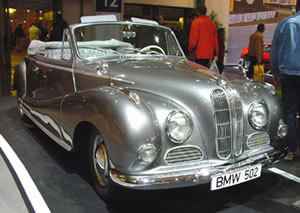
BMW 502 with lightweight alloy v8 engine.
In 1951 BMW introduced the six cylinder 501, a spacious sedan. This was followed by the 502 which featured a lightweight alloy V8 engine. During the 1950s BMW bought the design and manufacturing rights to the Isetta from the Italian company ISO. The vehicle was a 2-seater with a 250cc engine and proved to be immediately very popular. Manufacturing rights were sold to various companies around the world including the UK where they were produced by the British Railways works in Brighton.
In the mid 1950s BMW produced the BMW 507, a lightweight, V8 propelled sports car. Unfortunately the 507 didn't revive BMWs sporting image, as was intended. BMW were losing money on every 507 produced and so production ceased in 1960.
In 1961 BMW introduced the BMW 1500, a 1499cc, four cylinder touring cedan that was to prove immensely popular. It was the first of the modern sports sedan vehicles for which BMW are now renowned. Further development by the talented BMW engineers led to the 1600, 1800 and the famous BMW 2002. These vehicles significantly improved BMWs sales through the 1960s.
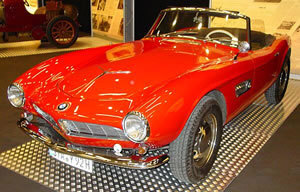
BMW 507 lightweight sports car
By the 1970s BMW had become established as an innovative automobile company pioneering many new technologies of the time. During this decade BMW introduced its will known 3-tier sports sedan range which consisted of the 3-series, 5-series and 7-series. At the same time they introduced their high performance range which included the limited BMW M1.
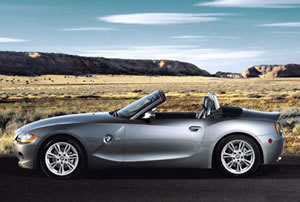
Today we still have the various BMW series. In 2004 BMW announced that they planned to make all odd number series saloon/sedan or estate/wagon models and all of the even number series would be 2-door coupes or cabriolets. In addition we see the X3, BMWs second SUV, and the Z4, a popular 2-seater roadster.
'코인관련' 카테고리의 다른 글
| Fiat 500 Abarth esseesse (0) | 2009.08.25 |
|---|---|
| History of 'Zara' (2) | 2009.08.25 |
| BMW History (2) | 2009.08.24 |
| BMW History - 1930s (0) | 2009.08.24 |
| The new four-door Porsche (0) | 2009.08.22 |


댓글 영역